
About CEA
Clean Energy Alliance (CEA) is the public, not-for-profit electricity provider for the cities of Carlsbad, Del Mar, Escondido, Oceanside, San Marcos, Solana Beach and Vista.
CEA generates clean power at competitive rates, while San Diego Gas & Electric (SDG&E) delivers it and handles billing. As a not-for-profit Community Choice Aggregator, CEA reinvests revenues into customer programs and projects that directly support our communities.
CEA offers three power options to our customers: Clean Impact (50% renewable energy), Clean Impact Plus (55% renewable, 75% carbon-free energy) and Green Impact (100% renewable energy). To learn more about these options, visit the Your Options page.
Community Choice Aggregation (CCA) is a model that enables communities to purchase power to meet their electricity needs, while the local investor-owned utility (SDG&E) continues to deliver it, maintain the grid and manage billing.
CCA programs can provide the communities they serve with competitively priced, clean energy choices while reinvesting into local projects and programs that support customers and our economy. Learn more about the history of the CCA model.
You may hear the term community choice energy (CCE) used interchangeably with CCA.
CEA serves residents and businesses in its member cities: Carlsbad, Del Mar, Escondido, Oceanside, San Marcos, Solana Beach and Vista.
CEA is a Joint Powers Authority led by a Board of local elected officials. The Board is composed of one City Council member from each member city. The Board sets rates, approves programs and hires the Chief Executive Officer and General Counsel. Day-to-day operations are managed by CEA staff, led by the Chief Executive Officer.
CEA is financed exclusively by the payments received from our customers. We do not receive tax dollars. As a not-for-profit public agency, we do not have corporate shareholders, and we do not earn profits.
Because CCA programs are locally managed, not-for-profit public agencies, any surplus revenues are kept local and reinvested directly back into our member communities through bill savings, incentives and local clean energy programs.
How It Works
Clean Energy Alliance (CEA) is responsible for purchasing and managing the electricity supply for customers in its member cities. This includes procuring power, setting generation rates and offering clean energy options that are competitive and locally governed.
CEA works with SDG&E to deliver cleaner electricity through the existing poles and wires. CEA does not deliver electricity, maintain power lines or send bills. Instead, CEA focuses on the generation portion of electricity service while reinvesting revenues into programs and projects that benefit the communities we serve.
CEA’s generation service replaces SDG&E’s generation charges and will appear on your regular electric bill as “CCA Electric Generation.” Read more about Understanding Your Bill.
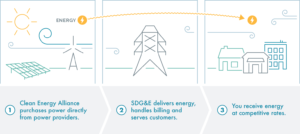
SDG&E continues to provide all electric delivery services, including:
- Sending customer bills and collecting payments
- Maintaining power lines, poles and substations
- Delivering electricity to homes and businesses
- Responding to outages and emergencies
Customers receive one bill from SDG&E, which includes CEA’s electricity generation charges alongside SDG&E’s delivery and regulatory charges.
SDG&E is responsible for maintaining and operating the electric grid, including infrastructure, meters and equipment.
Grid reliability and overall system coordination are overseen at the state level by the California Independent System Operator (CAISO). Whether a customer receives electricity generation from CEA or SDG&E, grid reliability and maintenance remain the same.
SDG&E remains responsible for outages and grid repairs. Call 1-800-411-7343 to report a power outage.
No. Grid reliability is managed by CAISO, regardless if power is provided by CEA or SDG&E.
Billing & Rates
All Clean Energy Alliance (CEA) customers also remain SDG&E delivery customers and receive one monthly bill from SDG&E.
CEA’s electric generation service appears as a separate page on your SDG&E bill under “electric generation charges.” Importantly, CEA is not an extra charge; CEA simply replaces the electric generation charge that you would otherwise pay to SDG&E. SDG&E continues to charge for the transmission and delivery of electricity, as well as various regulatory charges, taxes and fees.
Read more about Understanding Your Bill.
Rates vary based on energy market conditions and renewable content. Use our bill comparison tool to compare various electricity plans.
For current information on CEA’s rates, please view our Residential Rates page or Commercial Rates page.
You can also view an average cost comparison between CEA’s service options and SDG&E’s service on our Joint Rate Comparisons page.
Ensure the account number is entered exactly as shown on your SDG&E bill, including leading zeros and excluding spaces or special characters.
Yes. SDG&E power delivery charges (about 75% of your electric bill) apply to all customers, regardless of whether your power is purchased by CEA or SDG&E. CEA controls the generation side of CEA customers’ electricity bills: approximately 25% of the total cost. CEA customers can be affected by SDG&E’s rate changes for transmission and delivery, the same as non-CEA customers.
The Power Charge Indifference Adjustment (PCIA) is an SDG&E-set fee required by state law. It ensures that remaining SDG&E generation customers do not pay costs for energy previously purchased on behalf of customers who later join CEA. However, remaining SDG&E customers also pay the PCIA, which is built into total rates.
For more information, take a look at our PCIA Fact Sheet.
Yes. Because each power option is made up of a different mix of energy sources, they each have slightly different rates. Learn more about our current residential and commercial rates on our Billing & Rates page.
Enrollment & Participation
Per California Assembly Bill 117, customers within Clean Energy Alliance (CEA) service territory are automatically enrolled in our service. Service began in Carlsbad, Del Mar and Solana Beach in May 2021, with further enrollment occurring in Escondido and San Marcos in April 2023 and Oceanside and Vista in April 2024. Each City Council voted to join CEA.
Any residents or businesses with solar panels or other self-generation systems were automatically transitioned into CEA’s Net Energy Metering program at the time of their annual true-up with SDG&E to ensure that all true-up credits and relevant true-up period details were not impacted by the transition.
Yes. Participation in CEA’s electricity generation service is completely voluntary. Customers will always have the option to opt up, opt down or opt out.
Yes. If customers opt out of CEA before or within the first 60 days of service, they may return at any time. Customers who opt out after the first 60 days of service with CEA are prohibited by SDG&E from returning to CEA for one year.
To return to CEA, customers should contact customer service at (833) 232-3110 or askcea@thecleanenergyalliance.org.
Yes. You are able to opt up or down to our three different service options — Clean Impact, Clean Impact Plus and Green Impact — at any time. Head to the Your Options webpage to learn more about each service option.
Power Mix & Clean Energy
Clean Energy Alliance (CEA) purchases electricity from a diverse mix of energy resources, including renewable sources such as solar and wind, as well as other eligible energy resources available in the wholesale energy market.
CEA procures power through long-term contracts and market purchases to ensure reliability, price stability and compliance with state clean energy requirements. The electricity CEA purchases is delivered over the same shared grid that serves all California customers.
Renewable energy content is verified through state-mandated tracking and reporting systems overseen by California regulators.
CEA’s power supply and renewable energy claims are tracked using certified renewable energy credits and reported annually through Power Content Labels and other required filings reviewed by the California Public Utilities Commission. These disclosures ensure transparency and accuracy regarding energy sources.
No. CEA does not own or operate power plants.
Like most Community Choice Aggregators, CEA procures electricity from third-party energy producers through contracts and market purchases. This approach allows CEA to remain flexible, manage risk and adapt its power portfolio over time as technologies and market conditions evolve.
CEA supports California’s clean energy goals by:
- Procuring electricity that meets or exceeds state renewable energy standards
- Reducing reliance on fossil fuels over time
- Supporting the development of renewable energy resources through long-term contracts
- Reinvesting revenues into local programs and initiatives that promote energy efficiency, electrification, and sustainability
- Working to power our members with carbon-neutral electricity by 2035, ten years before California’s goal of carbon neutrality by 2045
Through these actions, CEA helps advance statewide climate goals while keeping decision-making and benefits local.
Governance & Transparency
Clean Energy Alliance (CEA) is governed by a Board of Directors made up of locally elected officials from each of its member cities. The Board is responsible for setting policies, approving rates and programs, adopting budgets and overseeing CEA’s long-term direction.
Each member city has equal representation, ensuring that decisions reflect regional collaboration and local priorities rather than private shareholder interests.
Yes. All CEA Board meetings are open to the public and conducted in accordance with California’s open meeting laws.
Meeting agendas, materials and recordings are posted publicly, and community members are welcome to attend and observe the decision-making process.
Community members can provide input by:
- Attending CEA Board meetings and offering public comment
- Submitting written comments to the Board or CEA staff
- Participating in community meetings, workshops and outreach events
CEA encourages public engagement and values feedback as part of its commitment to local, community-driven governance.
CEA operates as a public, not-for-profit agency and is subject to state laws governing transparency, financial reporting and public records.
CEA ensures accountability by:
- Holding publicly noticed Board meetings
- Publishing budgets, rates and key governing documents
- Undergoing regular financial audits
- Reporting required information to state regulators
Because CEA is governed by local elected officials, Board members are directly accountable to the residents of their communities.
Customer Support
It depends on the type of question:
- Contact Clean Energy Alliance (CEA) Customer Service with questions about electricity generation charges, CEA rates, programs or enrollment status
- Contact SDG&E with questions about delivery charges, meter readings, payment arrangements or service addresses
Both charges appear on a single SDG&E bill, but they are managed by different organizations.
Customers can contact CEA Customer Service at:
- Phone: (833) 232-3110
- Email: askcea@thecleanenergyalliance.org
Customer Service representatives can assist with questions about CEA service options, rates, enrollment status and generation charges.
Yes. Language assistance is available for customers who prefer to receive support in a language other than English.
Customers may request language assistance when contacting CEA Customer Service.
If you believe there is an error on your bill:
- Review the bill to identify whether the issue relates to generation charges or delivery charges.
- Contact the appropriate provider:
- CEA for questions about generation charges or enrollment
- SDG&E for questions about delivery charges, meter readings, or payments
Both organizations work together to help resolve billing questions as quickly as possible.
Special Topics
If you have solar panels or other renewable generation at your home or business, you may be eligible to offset your energy costs or earn credits for excess power you send back to the grid. Clean Energy Alliance (CEA) customers retain their Net Energy Metering status when they enroll with CEA and may participate in the Personal Impact or Solar Impact programs.
For a full explanation of how Net Energy Metering works, how credits are calculated, how to enroll and answers to common solar-related questions, please see our Net Energy Metering Explained page.
What is the Base Services Charge on my electricity bill?
This is a flat, fixed SDG&E charge to cover a portion of the costs for building and maintaining the electric grid. It is collected through a fixed monthly fee instead of volumetric rates based on energy usage.
Why is there a new flat fixed charge?
The new flat fixed charge was authorized by legislation passed in 2022 (Assembly Bill 205), and was approved by the California Public Utilities Commission on May 9, 2024.
How is the new fixed charge structured?
Customers will be charged by SDG&E based on their placement into one of three tiers:
- Tier 3: $24.15 per month for all residential customers who don’t qualify for low-income discounts.
- Tier 2: $12.08 per month for customers in the Family Electric Rate Assistance (FERA) program or customers residing in affordable rental homes with incomes at or below 80% of their Area Median Income.
- Tier 1: $6.00 per month for customers enrolled in the California Alternative Rates for Energy (CARE) program.
Who does the flat fixed charge apply to?
The Base Charge will apply to all residential customers, regardless of their rate plan or whether they receive energy from CEA or SDG&E. This SDG&E charge will be on the energy delivery side of the bill to be used for grid maintenance. Exceptions include master-metered rates that are not sub-metered, separately-metered EV rates for customers whose primary meter has an income-graduated fixed charge (IGFC) and customers with rate schedules set to be eliminated by mid-year in 2026.
How does this restructuring of residential electric bills affect solar customers?
Solar customers are not excluded from paying the Base Services Charge, as their homes are also connected to the grid and still require the infrastructure, meters and other equipment needed to maintain it.
How were these costs paid previously?
Prior to the Base Services Charge, all costs for customer service and maintaining the electric grid had been included in the variable energy delivery rate, or price per kWh. With the restructuring, some of the costs for things like SDG&E’s call center, billing, transformers, meters and other equipment will be separated from rates and put on their own line on the bill.
When there’s a new power provider in town, you’re bound to have lots of questions! We’ve assembled some of the top concerns expressed by community members. Please see our Mythbusters webpage to learn more.